
Executive Summary
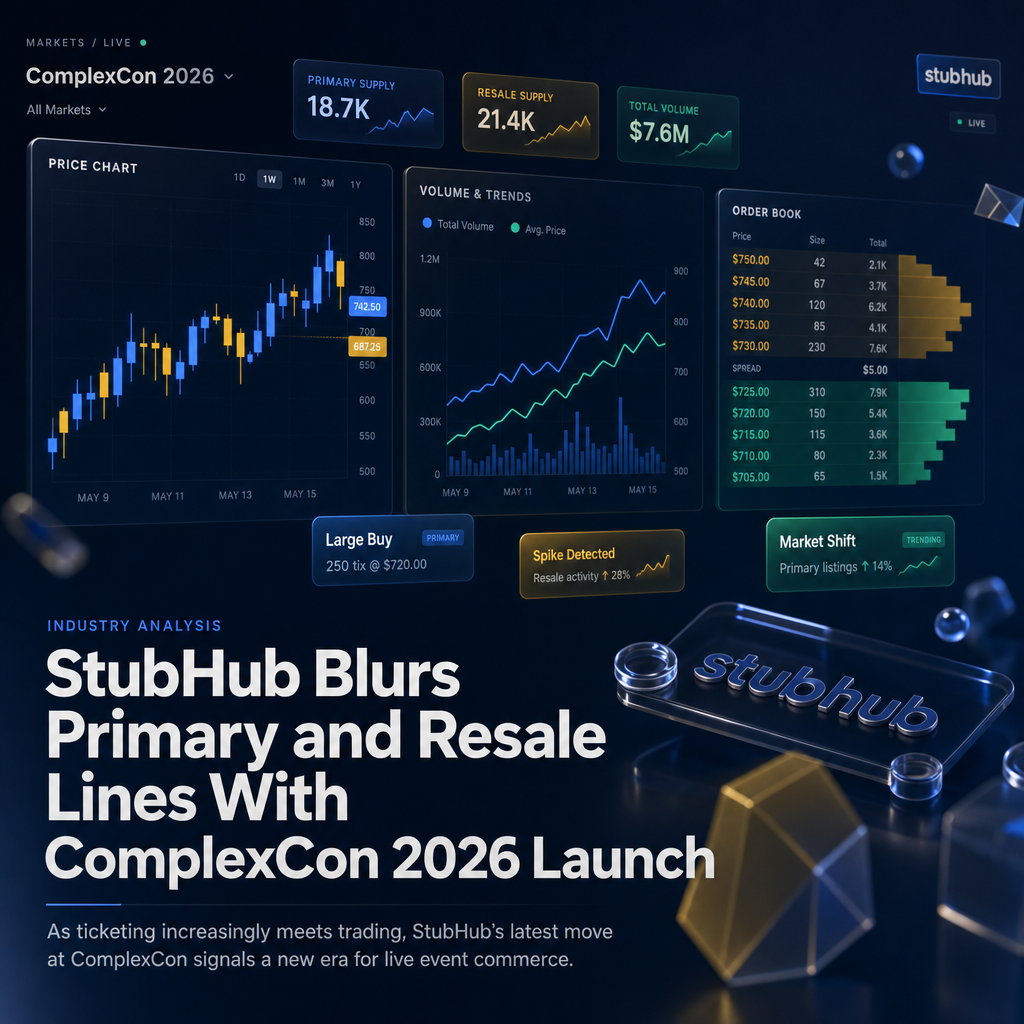
On September 14, 2026, StubHub was named the Official Distribution Partner for ComplexCon 2026 in Los Angeles—a milestone event as it marks the first case of “festival, concert, and bundle tickets” sold directly on a resale marketplace using StubHub’s Open Distribution model. Every ticket via this channel is covered by the FanProtect Guarantee. For brokers, this is not just headline news—it's proof that official primary inventory is beginning to live side by side with broker-managed supply in the same marketplace, compressing price discovery and sell-through into a single workflow.
ComplexCon, running October 3–4 across the Los Angeles Convention Center and Crypto.com Arena, features high-demand headliners Ken Carson and Playboi Carti, and offers both festival and bundled ticket options. StubHub’s Open Distribution program, recently reported by TicketNews to have roughly ten primary integrations already live, is scaling fast: a major U.S. baseball club has already racked up over $40 million in primary sales through this lane alone. These integrations let brokers operate in a mixed-channel environment, where primary and secondary listings appear together, reshaping pricing, pricing floors, and inventory velocity.
Marketplace results reinforce the opportunity. In Q2 2026, StubHub reported $3.1 billion in global secondary marketplace transaction volume and $573.1 million in company revenue—figures that indicate the platform’s capacity for massive deal throughput. Vivid Seats, emphasizing North America, totaled $659.4 million in gross order value and $129.9 million in company revenue in the same quarter, proving deep, ongoing buyer demand in the channels brokers already use. These are not industry-wide figures, but company results—they indicate where shopper attention and platform liquidity already reside, now further leveraged by official inventory flows.
Right now, ComplexCon creates actionable micro-markets: festival-only, arena-only, and bundled tickets are trading at divergent price points even weeks before doors open. Early secondary listing data shows a clear price segmentation between nights and between product types, offering savvy professionals the chance to model bundles, delta pricing, and run disciplined analytics playbooks in real time. ProTickets is the go-to platform for brokers ready to capitalize, providing deep event analytics, presale code automation, live market data, and actionable strategies tailored for professionals.
What "Official Distribution" on a Resale Marketplace Really Means
Open Distribution breaks down the classic wall between primary sellers and secondary marketplaces. Rights holders can list primary inventory directly on StubHub, with inventory shown and transacted side by side with broker resale listings. TicketNews confirms that roughly ten primary ticketing platforms are now connected and that StubHub views Open Distribution as a core growth engine, rather than a test project.
This shift is not limited to blockbuster festivals. Recent StubHub integrations with Spektrix and AudienceView bring Open Distribution to hundreds of performing arts groups, theaters, and campus venues across the U.S., Canada, the U.K., and Ireland, democratizing access for rights holders and presenting brokers with new verticals for growth. It’s a structural evolution: more and more primary inventory will be routed through systems already engineered for broker-driven liquidity and price discovery.
ComplexCon 2026: Real-Time Laboratory for Bundles, Price Floors, and Liquidity
StubHub’s partnership allows it to distribute “festival, concert, and bundled festival-and-concert packages” for ComplexCon directly on the platform, and all are protected by their guarantee. The real lever for brokers is bundling: official bundle products set a price floor for packages, which secondary sellers can undercut, match, or arbitrage by breaking up and repricing single-night components as demand for arena nights diverges from demand for the broader festival pass.
Demand is already splitting: Saturday’s Ken Carson headliner and Sunday’s Playboi Carti slot are trading at different levels on the secondary marketplace. Listings show arena nights starting in the high hundreds, with Sunday trending higher—a point-in-time indicator, not a universal average. Brokers should treat these numbers as live liquidity signals. The coexistence of fixed-price bundles and a fluid secondary market accelerates price discovery and enables brokers to execute nuanced split, merge, and price moves in real time.
Primary and Resale Under One Roof: Why Conversion Gets Easier
When fans see both primary and resale listings in a single interface, conversion rates rise. Ticketmaster’s own B2B studies highlight that showing all inventory together can increase event site traffic by as much as 20% when resale is enabled—a pattern rooted in visibility, frictionless shopping, and fewer buyer exits. While this data is from Ticketmaster, the same customer psychology applies at StubHub and other platforms: broader choice and instant comparison drive action.
StubHub’s Open Distribution delivers this blending of supply. For brokers, this means inventory is viewed alongside official tickets, making the “value gap” between face-value and market-clearing price instantly visible. This transparency makes the marketplace more efficient—price corrections happen faster, and products clear more rapidly than in siloed systems. For professionals with superior seats, targeted pricing, or specialized inventory, this is a conversion engine, not a challenge.
Quantifying the Channel: Platform Scale, Take Rates, and Broker Context
StubHub recorded $3.1 billion in global gross merchandise sales (secondary marketplace company GMV) and $573.1 million in revenue in Q2 2026. That’s a company-level take rate of roughly 19% for the quarter, reflecting the marketplace’s ability to absorb massive flows with robust fee structures. Vivid Seats, in North America, saw a marketplace gross order value of $659.4 million and revenue of $129.9 million in the same period, with reported company take rates in the “mid-teens.” These aren’t broker profit figures—they’re platform slice data—but they lay out the economics within which brokers make dynamic pricing and floor-tracking decisions.
One outlier from TicketNews: a major MLB team drove $40 million in primary ticket sales through StubHub’s Open Distribution. This is an exception, not typical, but it’s undeniable proof that rights holders have confidence placing volume directly on the same platform where brokers drive secondary-market liquidity. The implication: “official” tickets and broker inventory are now cohabiting on the highest-traffic shop windows in the business, enabling new strategies—and new profits—for professionals who recognize the signal.
Open Distribution's Impact on Day-to-Day Broker Strategy
Having official inventory next to broker listings sharpens professional strategy in three core ways: it defines anchor prices for shoppers (price floors), it expands the product assortment visible to fans, and it adds predictability to inventory refresh cycles. When a primary bundle sets the floor, a broker can either split the parts to suit specific buyer preferences or compete directly by offering superior seat locations or bundled value-enhancers.
This market structure emphasizes micro-tactics. If Sunday’s demand suddenly outpaces Saturday’s, brokers can pivot—splitting bundles or repackaging to maximize aggregate yield. When the primary adds new inventory, it opens a liquidity window; brokers able to adjust offer prices and availability in response can capture immediate volume. This granular, data-informed approach is exactly where experienced brokers outperform passive listers.
Opportunities for Brokers
- Use the ComplexCon rollout as a test bed for Open Distribution: Track separate SKUs for bundled, arena-only, and convention-only tickets. Watch cross-elasticity—the price deltas between these SKUs will change rapidly approaching event day.
- Leverage official floors to optimize value: Place the highest-quality seats just above primary bundles and highlight advantages such as better sightlines, pairings, or aisle locations. In a conversion-driven environment, these details can drastically improve sell-through velocity.
- Arbitrage bundle splits: If pricing for Saturday softens while Sunday’s surges, splitting a bundle can yield greater returns than the packaged price. Reevaluate after every primary inventory refresh; each event will present unique arbitrage setups.
- Be ready for late-stage price surges and micro-mispricings: As the event nears, buyers pay premiums for specific seats or dates. Tools that watch for short-lived pricing gaps let you deploy capital rapidly for consistent edge-capture.
- Apply take rate analysis to set floors and contribution minimums: Platform take rates (StubHub at 19%, Vivid Seats in mid-teens for Q2 2026) aren’t your net, but they’re a key modeling input to decide optimal pricing strategy and entry/exit points per event.
- Anticipate new primary integrations across more verticals: With recent Spektrix and AudienceView launches, expect theatre, campus, and performing arts events to appear in these blended marketplaces. Start building vertical-specific pricing and inventory strategies now.
Conclusion
Open Distribution is no longer an experiment. StubHub’s ComplexCon 2026 deal is the clearest signal to date that primary and secondary inventory will trade side by side at scale—transforming how brokers execute pricing, bundling, and inventory moves. With at least ten primary integrations already live, accelerated by theater and campus venue partnerships, brokers now operate in an environment where liquidity and price discovery power are stronger than ever before.
For professional secondary-market professionals, this landscape rewards rapid analysis, strategic positioning, and tactical execution. Build workflows for bundle arbitrage, anchor pricing, and event-specific value communication—and prepare for vertical expansion as more rights holders align with the marketplace model. The future of ticket resale is now co-located and conversion-driven. ProTickets empowers brokers to excel in this new normal, delivering real-time analytics, market-tested playbooks, presale code management, and precision tools built for consistent wins across sports, concerts, festivals, and beyond.
Ähnliche Artikel


Bereit, Ticketbroker zu werden?
Treten Sie ProTickets bei und erhalten Sie Zugang zu professionellen Tools, Live-Daten und Insider-Strategien, denen Top-Wiederverkäufer vertrauen.
Kostenlos loslegen