
Executive summary
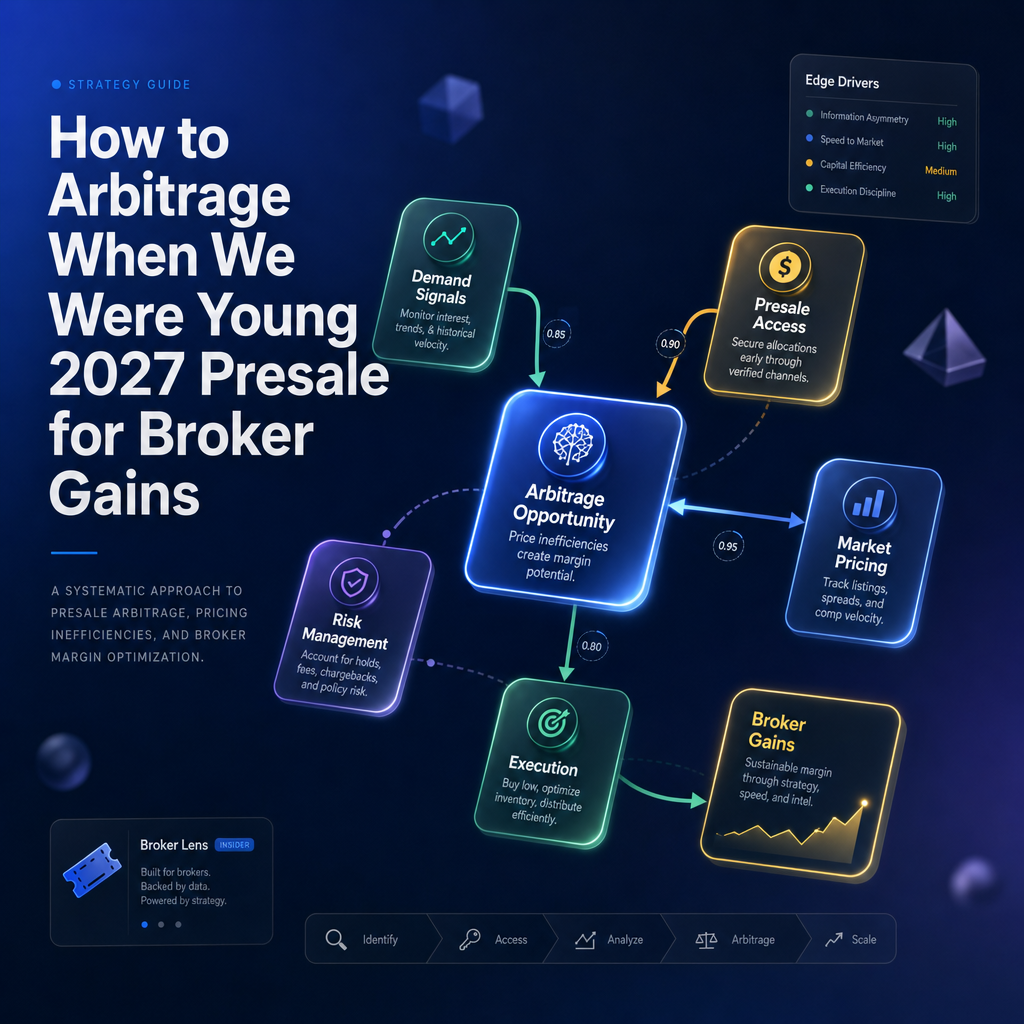
When We Were Young 2027, presented by 7-Eleven, is set to return to Las Vegas Festival Grounds on October 16, 2027, bringing top acts like Blink-182 and Pierce The Veil to an already electric lineup. Producers launched a ticket presale on November 20, 2026, with the rare move of publishing a one-hour “lowest price guaranteed” window for General Admission (GA) tickets—an ideal, time-boxed arbitrage opportunity for professional ticket brokers willing to move fast.
Primary price ladders were transparently revealed: GA Tier 1 debuts at $289.99 and Tier 2 at $319.99, while higher categories like GA+ and VIP start at $399.99 and $599.99, respectively. Some premium segments were quickly flagged as “Sold Out/On Waitlist,” increasing urgency and resurfacing key broker strategies around scarcity and value. With layaway starting at just $19.99 down (primary, U.S., 2027), fan access expands, but incentive shifts toward higher-tier trades and last-minute buyers—an effect brokers can leverage for liquidity and pricing power.
Strategically, the festival directs all official secondary sales through Ticketmaster’s Verified Exchange, using Front Gate Tickets accounts, but excludes certain package types. This direct-from-primary resale flow not only streamlines fulfillment but also gives secondary-market professionals a frictionless, policy-approved exit route. The key opportunity: capture structured, underpriced primary tickets in the first hour, then route liquidity through the trusted exchange as true demand materializes.
Secondary market liquidity remains robust: StubHub (global) reported $2.62 billion in Q3 2026 gross merchandise sales and raised full-year GMS guidance to above $10 billion; Vivid Seats (North America) posted Q3 2026 GOV of $624.0 million, both figures at the company level—not total industry volume. Meanwhile, Ticketmaster tracked 33.2 million unique users in 117.6 million app sessions in 2026 alone, reinforcing event and onsale velocity. ProTickets empowers brokers to operationalize every edge here—offering real-time market analytics, presale code management, and proven workflows so professionals can decisively execute first-hour strategies.
The one-hour floor: how to win Tier-1 GA before the ladder climbs
The November 20, 2026 presale announced an “only during the first hour” guarantee for the lowest price GA. Brokers rarely get such clear, enforceable floors; this short window sets your event modeling and queue management on solid, quantifiable ground.
Operationally, prepare multiple pre-authenticated queues and devices pushed to the Front Gate cart endpoint, fully funded and tested. Target GA Tier 1 at $289.99 single-mindedly; secondary loads should flow next into available low-tier GA+ and VIP, but only if initial GA strikes are depleted. Each minute, the visible primary price steps (e.g., from Tier 1 to Tier 2 with a $30 increment) remind you that time truly is money.
Impose a hard stop as soon as your all-in average cost per ticket (ACP) approaches your calculated resale base line. Remember, the market’s most attractive inventory disappears inside this one-hour wedge—once primary ladders up, the risk/reward profile inverses.
Work with focused, tight blocks. Don’t be distracted by secondary categories early; prioritize speed and consistency, not diversification. Efficient carting and disciplined spending are your primary edge against slow-moving competitors.
Map the primary price ladder—and trade it
The festival makes things refreshingly explicit: each ticket type displays clear tiered pricing (such as GA Tier 1 at $289.99 and Tier 2 at $319.99) and status indicators (“Sold Out,” “Join Waitlist”) for each class. This enables brokers to visualize the “price staircase,” targeting clear resell deltas per tier, not just broad averages.
Moving from GA Tier 1 to Tier 2 means a $30 hike—which, multiplied across blocks and buyers, accumulates significant premium once external fees and Verified Exchange price comps are included. Brokers can apply similar logic across other ladders (GA+, VIP), but should be particularly deliberate with outliers.
At the very high end, VIP Cabanas start at $18,500 primary (ten tickets and hospitality): these are boutique products suited for corporate or luxury placements, not typical broker trades. GA+ and VIP near “Sold Out/Waitlist” status capture scarcity premiums; treat these early opportunities as distinct from general entrant blocks in your modeling.
Layaway options shift some fan demand into payment plans, which can slow secondary churn for standard GA and accelerate it in GA+/VIP—where convenience buyers dominate. Brokers should front-load GA+ and VIP trades early, while carving out a subset of GA tickets for later, schedule-driven buyers as demand reactivates pre-event.
Use the official Verified Exchange to simplify exits
All authorized resales run through Ticketmaster’s Verified Exchange, integrated with Front Gate accounts. For brokers, this provides a double benefit: tickets get legally and efficiently reissued in the buyer’s name, removing downstream delivery risk and boosting buyer confidence—a proven factor in tightening bid-ask spreads.
The festival specifically barres some categories (hotel packages, cabanas, group plans) from the Verified Exchange, so direct your acquisition strategy toward tickets with a compliant resale pathway. This not only safeguards your fulfillment, it also becomes a unique selling proposition—buyers gravitate to officially-sanctioned, fully-transferable inventory.
List early, but not all at once. Scale your asks as GA+/VIP liquidity tightens and “Sold Out” banners persist on primary. Operational discipline—auditing listings, maintaining account compliance, and documenting transfer—becomes a competitive edge in high-volume cycles.
Packages and travel demand: monetize convenience without violating policies
The festival’s hotel + ticket bundles (via Jampack) can’t be resold through Verified Exchange. Rather than resist, align your outbound strategy to attract travelers who prize the convenience of official packages but missed out, then competitively price your GA+/VIP accordingly. The key: sell certainty and superior access, not the prohibited hotel component itself.
Highlight travel predictability and event amenities in your listing language, especially for GA+ and VIP: lounge access, expedited entry, dedicated restrooms matter intensely to out-of-market buyers navigating Las Vegas. Use official VIP/GA+ amenity descriptions so you promise only what can be legitimately delivered, but don’t undersell the fan experience.
Keep your hotel blocks separate, flexible, and fully refundable—your real product is the confidence of compliant festival access and the comfort of premium experience, not the grey-market resale of bundle packages.
Liquidity signals, comps, and timing the curve
Industry liquidity is stronger than ever. StubHub (global, secondary platform) reported $2.62 billion in Q3 2026 GMS and boosted its 2026 full-year forecast to over $10 billion. Vivid Seats (North America) marked $624.0 million Marketplace GOV for Q3 2026, reflecting solid transaction depth; both measures are company-specific and do not represent the industry as a whole.
These liquidity flows mean that high-quality festival inventory—especially when cleanly acquired and listed via official exchanges—can move rapidly around onsale spikes and demand peaks. Corroborating this, Ticketmaster’s 2026 app engagement metrics (33.2 million unique users, over 117 million sessions) signal sustained event churn that should put WWWY in many users’ watchlists at presale.
Use past events as guidance, not prophecy: for example, TicketData tracked a final “get-in” (all-in GA secondary, Saturday) of $307 for WWWY 2023. Importantly, that’s a historical reference point; don’t let it anchor your forward pricing, as lineups, tiers, and travel patterns differ every cycle. Outlier prices, like $18,500 VIP Cabanas, must be modeled independently—not averaged into standard GA/GA+ projections.
Monitor category-specific medians and time your curve. Real-time platform data should drive your ask updates after the presale hour, allowing you to move early inventory near demand spikes while holding reserves for late-travel demand as show dates near.
Wristbands, fulfillment, and transfer mechanics
The festival runs on wristbands, with strict policy: only wristbands purchased through Front Gate Tickets or via Verified Exchange are valid for entry. This should be a cornerstone of your listing copy—buyers will pay a premium for the certainty that tickets will be delivered, reissued in their name, and honored at the door.
Your internal playbook should include wristband activation timelines, address assignment, and robust contingency mechanics for any will-call or last-minute exchanges. Adhering to official fulfillment standards is not just about policy, but about closing buyers who understand the value of authorized, guaranteed delivery.
Categories excluded from Verified Exchange (hotel, cabanas, group plans) should only be handled if dealt with as concierge placements—not as ordinary resales. Making compliance your default isn’t just legal best practice—it’s a direct path to conversion wins and customer trust.
Opportunities for brokers
- First-hour GA capture: Build your operation around the November 20, 2026, 10–11 a.m. PT presale, focusing all efforts on GA Tier 1 at $289.99. Pre-stage devices, queue slots, and locked payment caps; exit as soon as ACP aligns with your base resale case.
- Trade the staircase, not the average: Model each price tier as its own product. The $30 primary step up from Tier 1 to Tier 2 matters—move strong Tier 1 blocks fast and time-tiered opportunities for late-traveler demand.
- Exploit GA+/VIP scarcity: “Sold Out/Waitlist” indicators on premium tiers boost spread. Test early exchange liquidity with small, confidently priced blocks, and always log category specifics on your ledger.
- Exit on the official rail: Confirm all resales happen via Ticketmaster’s Verified Exchange. This lowers buyer risk and can warrant a price premium, with strict adherence to category eligibility.
- Sell on experience, not just comps: For travel buyers, GA+/VIP amenities—lounge, restrooms, quick entry—are as valuable as ticket price deltas. Craft copy to emphasize value they can use.
- Monitor curves with real data: Leverage StubHub GMS and Vivid Seats GOV to gauge liquidity; adjust pricing when depth tightens and post screenshots for category medians. Historical “get-in” numbers are guardrails, not future promises—calibrate live as demand shifts.
Conclusion
By publishing a presale hour with locked-in discounts and enforcing full transparency on both price ladders and exchange rules, WWWY 2027 turns its onsale into a broker’s model scenario for value capture and professional execution. The blend of structured opportunity, segmented demand, and festival-approved resale rails swings the edge firmly toward disciplined, analytic secondary-market professionals. ProTickets stands as the premier partner to help brokers operationalize this playbook—leveraging unmatched event analytics, code management, and market insight to keep every professional ahead of the curve. The result: opportunity-driven market making, compliant fulfillment, and a repeatable pathway to broker success in music’s most dynamic ticketing arena.
Sources cited: Live Nation Entertainment newsroom announcement for WWWY 2027 and presale window (2026, U.S., primary market); When We Were Young ticket page and help center (secondary policy, 2026 U.S.); StubHub and Vivid Seats Q3 2026 corporate releases (company-level secondary market platform data); Ticketmaster Business 2026 app engagement; TicketData (historical 2023 WWWY final get-in, secondary market).
Gerelateerde artikelen

Klaar om ticketbroker te worden?
Sluit je aan bij ProTickets en krijg toegang tot pro-tools, live data en insider-strategieën die door topverkopers worden vertrouwd.
Gratis aan de slag