
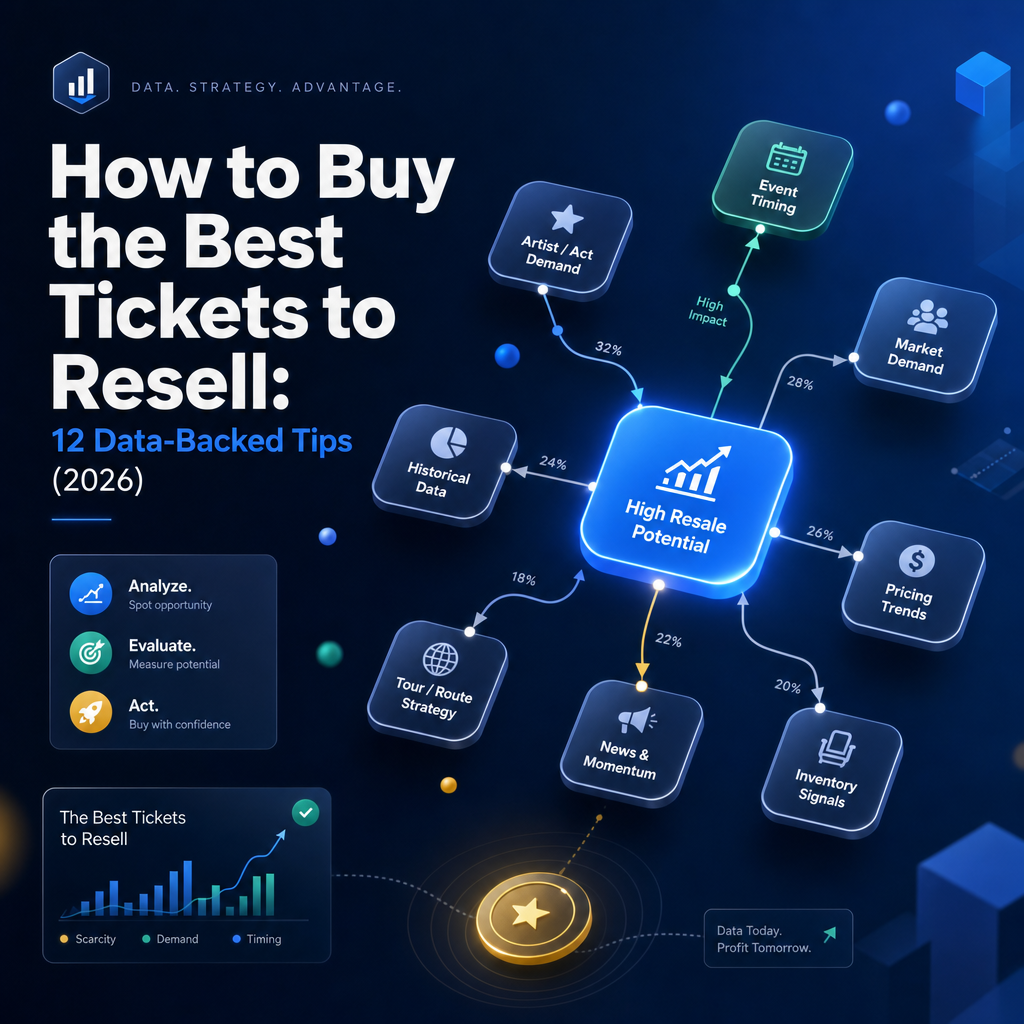
Most people lose money reselling tickets for one reason: they buy what is easy to buy, not what is hard to buy. The tickets sitting in the open market at face value are usually the ones nobody else wanted, which means you are competing to sell the exact inventory the primary market already could not move. Profitable resale is the opposite. It starts before the on-sale, with a clear read on demand, and it ends with seats that a real buyer will pay a premium for at the door.
This is an operational playbook, not a pep talk. Below are 12 tips built around a simple framework: read demand before the market does, buy the seats that hold value, respect the buy limits and rules, and price against real sold data instead of hope. We will use concrete numbers throughout, and we will point to the specific tools that make each step faster. The goal is to turn ticket buying from a gamble into a repeatable process where the margin is decided at purchase, not at sale.
The Demand-Reading Framework
Before any individual tip, internalize the three signals that drive resale value. Almost every good buy scores well on at least two of them.
- Audience finances. Who buys this artist or team, and what can they pay? A pop act with a 30-to-50-year-old professional fanbase resells very differently from a niche indie act with a student crowd. Disposable income sets the ceiling.
- Area and market. A single date in a metro of 6 million with one show resells better than a 12-date residency or a tour that hits three nearby cities in one week. Scarcity is local. The same artist can be a strong buy in one market and a money pit two states over.
- Niche and fan intensity. A devoted, obsessive fanbase that travels and buys multiple shows beats a casual audience that is mostly there because the date was convenient. Intensity, not just size, is what pays a premium.
Put numbers on it. A face value $120 lower-bowl seat for a one-night-only arena stop by an act with an affluent, intense fanbase can clear $300 or more on resale, a 2.5x gross. The same $120 seat for a mid-week show on a multi-date run with a casual crowd may sit below face. Same artist, same building, completely different trade, because the three signals point in opposite directions.
The 12 Tips
1. Read demand before the market does
The edge in resale is timing your read, not your sale. By the time an event is trending on social media and resale prices have already jumped, the easy margin is gone. You want to identify high-demand events while tickets are still at face value, ideally before or during the on-sale. That means studying the artist's recent history: did their last tour sell out, did secondary prices hold above face, are they playing smaller rooms than their draw justifies (a deliberate scarcity play that resells well).
This is where market data does the heavy lifting. ProTickets tracks more than 250,000 events across 50,000 venues with availability, pricing ranges, and historical trends. Instead of guessing whether an artist holds value, you can look at how their comparable dates have actually behaved and let the data tell you whether demand is real or hype.
2. Know which genres, sports, and comedy actually hold value
Not all live events resell the same. As a general rule, the categories that reliably hold or grow value share a trait: limited supply against an intense, higher-income audience.
- Marquee pop and legacy tours with single-night metro stops and travel-ready fanbases tend to be the strongest and most liquid.
- Playoff and championship sports are elastic gold because supply is fixed and demand spikes overnight; regular-season weeknight games against weak opponents are the opposite.
- Top-tier comedy in theaters can be quietly excellent: small rooms, no obstructed-view problem, and fans who decide late.
- Festivals and residencies are riskier because supply is large and dates are interchangeable, which caps scarcity.
Match the category to the three signals. A weeknight regular-season game fails the scarcity test; a one-off comedy taping in a 1,200-seat theater passes it.
3. Buy the sections and seats that resell best
Section choice is where most of the margin lives, and most beginners get it wrong. Resale buyers pay up for proximity, sightline, and a clean experience. The seats that consistently outperform:
- Lower bowl and front sections closest to the stage or court. These are the first to disappear and the last to drop in price.
- Pit and floor for concerts where standing close is the whole point, often the highest multiples of any inventory.
- Aisle seats within a good section, which command a premium for easy in-and-out access.
- Center sections over far-side or behind-stage, even at the same level.
Avoid the value killers: obstructed-view, limited-view, and side or rear sections that the venue itself flags. A seat that says partial view in the listing can lose 40 to 60 percent of its premium instantly. The ProTickets Price HeatMap in the Chrome extension colors every available seat by its exact price, so you can see at a glance which sections are priced like value and which are priced like leftovers, without clicking through hundreds of listings.
4. Compare face value to the resale ceiling, not the floor
A ticket is only a good buy if there is real room between what you pay and what the market will actually bear. Beginners anchor on the highest resale price they can find and assume they will hit it. Professionals price to the realistic ceiling: the level where comparable seats have actually sold, after fees, with time to spare before the event.
Concrete example: you buy a lower-bowl seat at $120 face. Current resale listings show $350, but recent sold comparables for that section cluster at $260 to $290. Your working ceiling is roughly $275, not $350. After typical selling fees of 10 to 15 percent you net around $235, a clean profit on $120 in. ProTickets surfaces resale and sold market data precisely so you can set that ceiling on evidence instead of the most optimistic listing on the page.
5. Use presales to buy before the public
The single biggest structural advantage in buying is access before the general public. Presales (artist, fan club, credit card, venue, and promoter) let you reach the best inventory while it is still at face value and before resale prices have formed. The seats you can get at 10 a.m. on presale day are routinely better than anything left when the public on-sale opens.
The hard part is that presale codes are scattered across dozens of sources and time windows. ProTickets maintains a presale code database and calendar so you are not hunting for codes the morning of, and the ProTickets Inbox helps you capture codes and manage the accounts tied to each presale. Getting in early is not luck; it is preparation.
6. Time your buy with the demand curve
Buying early at face is the default winning move, but timing also applies to the open market. Prices follow a curve: high right after on-sale (FOMO), a soft middle period for events without urgency, and then a sharp move in the final 72 hours as the event approaches and undecided buyers commit. For genuinely high-demand events, prices climb into the door; for soft events, they collapse.
Your job is to know which curve you are on. If the three demand signals are strong, hold and sell late into rising prices. If they are weak, sell early before the floor falls out. Reading historical price trends for similar events tells you which pattern to expect, so you are not guessing whether to hold or dump.
7. Respect buy limits and use multiple accounts the right way
Most high-demand on-sales cap purchases at 4 to 8 tickets per account, per event, sometimes tied to a single payment method or billing address. That cap is the constraint on your inventory, so plan around it. Operators legitimately spread purchases across multiple distinct accounts to acquire more inventory, but the accounts must be clean: real, distinct identities and details, not obvious duplicates that get flagged and canceled.
This is operational overhead, and it is where ProTickets Inbox plus the buyer account generator save time, helping you organize accounts and capture the codes and confirmations tied to each one. Whatever you do, follow each platform's rules and terms; canceled orders from duplicate-account abuse are a fast way to lose both inventory and the account.
8. Avoid VIP packages that do not resell
VIP and premium packages look attractive because the seats are great, but many are a trap for resellers. Packages bundled with merchandise, early entry, or meet-and-greets are frequently non-transferable, tied to the buyer's name, or simply not in demand on the secondary market because the perks expire the moment the show starts. You can pay a $400 VIP price for a seat whose resale value is the same $150 as the standard ticket two rows back.
Before buying any premium tier, confirm two things: that the ticket itself is transferable, and that the seat (stripped of the perks) is worth the premium on its own. If the value is all in non-transferable extras, it is a consumer purchase, not a resale buy.
9. Watch for dynamic pricing and inflated face value
Dynamic or platinum pricing means the primary price can climb in real time as demand rises, sometimes above where the resale market will settle. The trap is buying a dynamically priced ticket at $450 because it feels exclusive, only to find the resale ceiling is $380. When primary pricing is dynamic, your margin can be negative before you even own the ticket.
The defense is to always compare the live primary price to actual resale and sold data in the same moment. If the primary price has been pushed near or past the resale ceiling, walk away. There is no rule that says you must buy; discipline on entry price is the difference between a business and a hobby.
10. Screen out transfer and ticket restrictions before you buy
A great seat you cannot legally transfer is worthless as resale inventory. Increasingly, events use restricted, delayed-transfer, or non-transferable tickets, mobile-only entry tied to the original account, or paperless will-call that requires the buyer's ID and card at the door. Each of these can make resale impossible or force a risky workaround.
- Check the transfer policy on the event page before the on-sale, not after you have paid.
- Avoid will-call and ID-at-door events for resale unless you have a tested delivery method.
- Note delayed-transfer windows; tickets that only become transferable days before the event compress your selling time.
Restrictions are not always a dealbreaker, but they are always a discount to the price you should be willing to pay, because they shrink your pool of buyers and raise your delivery risk.
11. Price with sold and comparable data, not feelings
When it is time to sell, your number should come from evidence. The two inputs that matter are sold comparables (what identical or adjacent seats actually transacted for) and the current active listings you are competing against. Listing prices alone are noise; many are aspirational and never sell. Sold data is the truth.
Practically, anchor your list price slightly below the lowest comparable in your seat tier so you are the rational buyer's first pick, then adjust as the event approaches and supply thins. ProTickets resale and sold market data gives you both sides of that calculation, so you set a price that actually moves inventory instead of a price that just sits there until the event passes and the ticket is worth zero.
12. Use monitors to catch price and availability moves
You cannot watch every event by hand, and the best buying and selling windows open and close fast: a price drop, a sudden release of held-back inventory, a competitor undercutting the section you are sitting on. Automated monitoring turns those moments into alerts instead of missed opportunities.
ProTickets monitors track availability and price moves on the events you care about, so you are notified when a section opens up at face value or when the resale floor shifts under your listing. Combined with the market data and the Price HeatMap, monitoring closes the loop: you see demand early, buy the right seat, price against real data, and react the instant the market moves.
Managing Risk
Two rules keep resellers solvent. First, do not overpay on entry. Margin is made when you buy, and no selling skill rescues a ticket bought above its realistic ceiling. If the numbers do not clear after fees, pass; there is always another event. Second, diversify. Do not put your whole budget into one show, one artist, or one section. Spread across several events with strong demand signals so that one soft show or one canceled order does not wipe out the month. Treat each buy as a position with a defined downside, and size it accordingly.
Frequently Asked Questions
What is the single best section to buy for resale?
There is no universal answer, but lower-bowl and front sections closest to the action, plus pit or floor for concerts, are the most reliably liquid because they sell first and hold price longest. Aisle seats within a strong section add a further premium. Avoid anything flagged obstructed or limited view.
How much margin should I expect on a good buy?
It varies widely, but a strong demand event can return 2x to 3x face on the best seats, while many solid buys clear a more modest 20 to 50 percent after fees. The discipline is in only taking trades where the resale ceiling clearly exceeds your all-in cost, not in chasing a fixed number.
Are multiple accounts allowed?
Buy limits exist precisely to cap per-account purchases, and platforms enforce them. Many operators spread buying across distinct, legitimate accounts to acquire more inventory, but you must follow each platform's terms; duplicate or fraudulent accounts get flagged and orders get canceled. Keep accounts clean and distinct.
How do I avoid buying tickets I cannot resell?
Check the transfer policy before you buy, skip non-transferable VIP packages and ID-at-door events unless you have a tested delivery method, and treat delayed-transfer windows as a discount to your bid. A seat you cannot deliver is not inventory.
Putting It Together
The reseller who wins in 2026 is the one with better information and better timing, not the one who refreshes hardest on on-sale day. Read demand with the three signals, buy the sections that hold value, get in early through presales, screen out the restriction and pricing traps, and price your sales against real sold data. Then let monitors and market data do the watching so you act when the window opens rather than after it closes.
ProTickets is built for exactly this workflow: market data on 250,000+ events across 50,000+ venues, the Price HeatMap that colors every seat by price, resale and sold data to set your ceiling, a presale code database and calendar, the Inbox and buyer account generator to manage accounts and capture codes, and monitors for availability and price moves. Plans run Lite at $9.99, Pro at $29.99, and Premium at $99.99 per month. Start reading demand before the market does at ProTickets and turn ticket buying into a repeatable, data-backed process.
Related articles


Ready to become a ticket broker?
Join ProTickets and get access to pro-grade tools, live data, and insider strategies trusted by top resellers.
Get started for free