
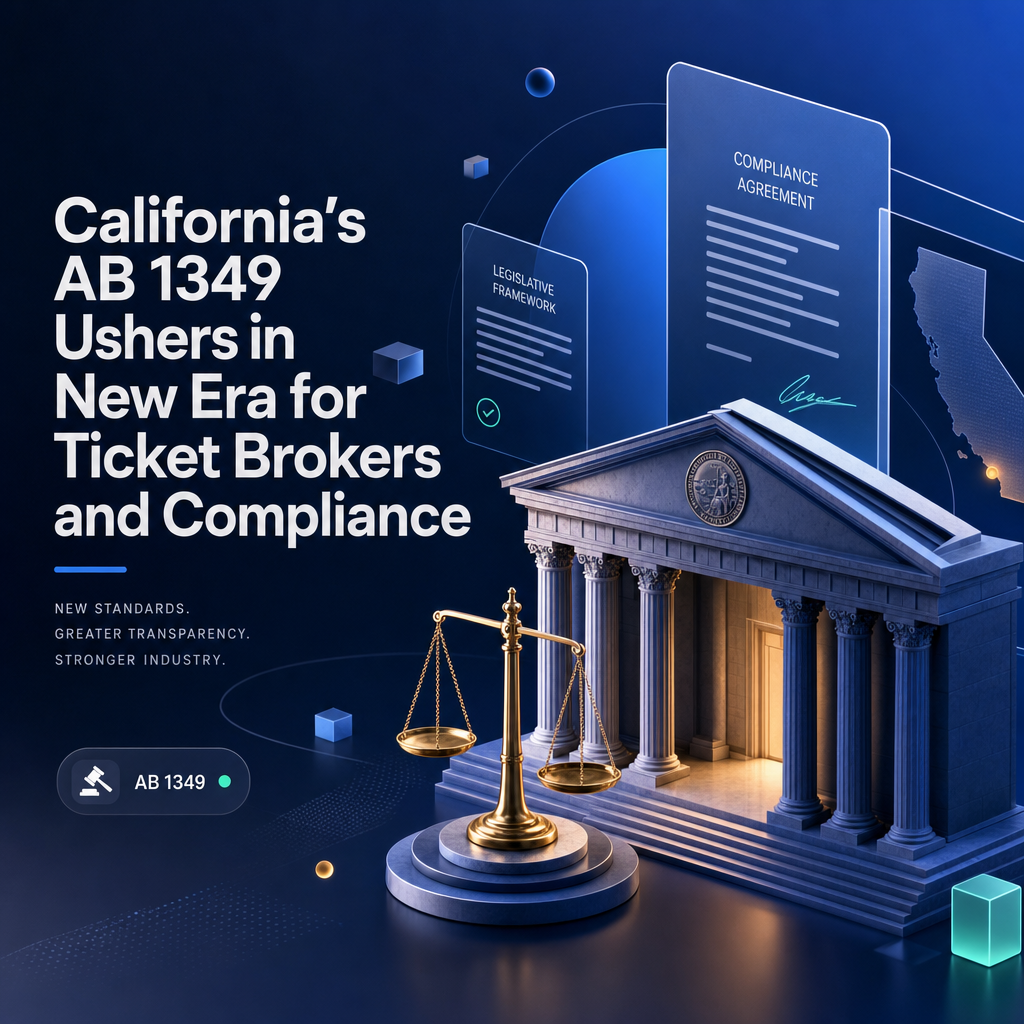
Executive summary
On September 27, 2026, California enacted AB 1349, a consumer protection measure that prohibits speculative—or so-called “ghost”—ticket listings where the seller does not yet own or have an enforceable right to deliver the seats. The law explicitly outlaws such speculative posts, bans use of software to bypass ticket limits or online queues, and clamps down on misleading “authorized seller” lookalike sites. Civil penalties pack real punch: fail to deliver, and brokers can be liable for two times the contracted price, plus nonrefundable travel costs and attorneys’ fees. The law is set to take effect January 1, 2027, giving professionals a brief window to implement bulletproof compliance.
For the professional broker, this new standard is not a threat but a catalyst: it rewards operational rigor over speculation. AB 1349 creates a legal framework—centered on “constructive possession”—that allows pre-listing if you’ve fully paid, possess an enforceable right to the ticket, and secure written confirmation from the original seller or venue. No price controls exist; brokers who document ownership and maintain impeccable records stand to continue pricing dynamically while avoiding penalties that less disciplined sellers may face.
Market dynamics remain robust. Live Nation’s global primary ticket division tallied over 143 million tickets sold through mid-July 2026, with record deferred revenue of $6.4 billion—a signal that the event pipeline remains wide open. On the secondary front, Vivid Seats reported $2.70 billion in 2025 Marketplace Gross Order Value—a company-level resale transaction volume in North America. Regulatory complexity matches transactional opportunity, and only a compliance-first strategy can preserve profits at peak throughput. As leading tours like Oasis’ Live ’27 embrace official face-value exchanges and compress resale liquidity to late windows, proof of clean ownership will become a competitive edge. For brokers primed to operationalize these new requirements, ProTickets is the top choice: modern, real-time analytics and proven workflows to stay steps ahead.
What AB 1349 actually changes—and what it doesn’t
AB 1349 outlaws the listing, advertising, or sale of tickets that the broker does not own or cannot reliably claim with enforceable rights—unless they pass the law’s “constructive possession” test or have explicit permission from the event presenter or venue. This closes the door on pure speculative offers within California. Marketplaces will now need “reasonable measures” in place to block non-compliant listings and stop knowingly facilitating them.
The statute also bans the use of tech tools to surpass stated purchase limits, jump position in electronic queues, or sidestep anti-bot or presale controls. Furthermore, it formalizes prohibitions against website mimicry or unauthorized “official” branding designed to confuse buyers. Crucially, AB 1349 remains silent about where market prices can land; it regulates the means and methods of possession, not resale pricing itself.
Noncompliance triggers sharp penalties. Breach the rule and fail to deliver, and the buyer can sue for double the contract price of the ticket, plus trip expenses and legal fees—a massive deterrent when multiplied across typical order volumes. With an effective date of January 1, 2027, the compliance countdown has already begun.
Constructive possession: the legal doorway to continue pre-listing
AB 1349 positions “constructive possession” as the legal green light for pre-listing: brokers must have (1) fully paid for the ticket, (2) a legally enforceable right to receive or transfer it, and (3) written confirmation of assignment or purchase from an original provider, event presenter, or venue. This is the definitive safe harbor for pre-sale listings by professional brokers.
A compliance-first broker maintains organized, retrievable “possession files” on every order—digital records including payment confirmation, the underlying contract or assignment language granting enforceable rights, and official written communications or invoices from the ticket issuer. California’s regulatory posture means holding these files for at least twelve months past transaction to demonstrate lawful status if challenged.
Valid examples: paid-in-full season ticket invoices that include explicit transfer or assignment rights, official venue or promoter assignment letters for suites or premium access, and paid primary invoices for delayed-delivery events. Commonly non-compliant: mere waitlist positions, “holds” without enforceable agreements, and speculative claims on anticipated drops. The mission is clear—document everything, and convert every pre-list into a “right to deliver” asset.
Listing language, ad hygiene, and site UX that pass scrutiny
AB 1349 elevates accurate ad copy and transparent user experience from good practice to legal requirement. Do not suggest or imply primary-channel status if you are reselling; never declare seats “sold out” if the box office retains inventory; and only list specific seats or rows if you can back it up credibly and promptly.
Branded landing pages, microsites, and ad domains must not mimic or mislead—no “substantially similar” web addresses, design stylings, or favicon that might miscue consumers into thinking they are buying from a primary source. If you’re running niche or geo-targeted landing pages linked to major on-sales, flag your status as an independent reseller clearly in both page headers and throughout checkout. This protects brand reputation and satisfies regulators that your business does not misrepresent its status.
Operationally, build disciplined marketing content reviews: when the primary market reopens inventory or changes its pricing, update your copy immediately. Treat your marketing claims with the same rigor as seat inventory—fast removals reduce risk of citation or complaint.
Queue and limit compliance: scaling acquisitions without crossing the line
The new law bans the use of software or services to break ticket limits, subvert online queueing systems, or bypass any presale or anti-fraud mechanism. This aligns with existing platform rules but now exposes brokers to statutory damages under California law if they cannot substantiate a valid, lawful purchase tied to what they list.
Build an acquisition team that plays strictly within the posted limits—leveraging unique, authorized accounts and trained human operators, rather than automation or tools that simulate artificial demand. Maintain a “purchase-limit ledger” for every major tour or high-velocity event: this tracks seat limits by account and individual, ensuring you stay within event parameters and maintain credibility on each purchase batch.
For presale activity, keep documentation on the source, nature, and permissible use of each access code and ensure any acquisition pattern mirrors issuer rules exactly. When timelines for ticket delivery are delayed or exchanges mandate later issuance, it is best to under-promise on fulfillment dates and build an in-house reserve of similar owned inventory as an instant fix for rare fulfillment failures. This is not only a legal shield—it is a customer-service asset.
Primary–secondary dynamics to watch as you implement AB 1349
Primary ticket sales volumes are hitting historic highs. Live Nation reported over 143 million tickets sold through mid-July 2026 and a record $6.4 billion in deferred revenue for its global primary market business, indicating a well-stocked supply pipeline as 2027 approaches. On the secondary side, transaction value remains robust—Vivid Seats reported $2.70 billion in 2025 Marketplace Gross Order Value, reflecting North American resale flows just on one major platform.
Mega-tours are also experimenting with face-value-only secondary options. Oasis’ 2027 tour, for example, sold out 42 stadium shows in days, with official resale strictly at face value through Ticketmaster’s Face Value Exchange and Twickets, but only closer to event dates. These platforms compress liquidity and demand even greater discipline from secondary-market professionals—favoring those with pristine possession documentation and nimble, just-in-time delivery methods.
California’s approach—defining possession standards, banning queue circumvention, and clarifying truth-in-advertising—widely mirrors initiatives other states are actively considering. Brokers who perfect California compliance will be setting the pace for national best practices and market expansion, not building limited-use systems.
Risk math under the new damages rule—and how to hedge it
The core risk under AB 1349 is clear: breach one of the main possession or marketing sections and, if unable to fulfill, the broker faces liability for twice the contract price per seat, plus travel costs and attorneys’ fees. For a typical order of four tickets at $650 each on the secondary market, this would equal $5,200 in statutory exposure before buyer expenses—a potentially devastating impact if not meticulously managed.
The mitigation playbook is simple: engineer your internal workflows to prevent any “can’t-deliver” incidents. This includes assembling possession files for every ticket listed, setting conservative delivery date estimates for time-released inventory, and maintaining a reserve pool of comparable seats (3–5% of volume) to address unforeseen fulfillment issues instantly. Adding a final confirmation step at checkout—collecting and archiving contracted price data—can insulate against disputes over price if claims arise.
Opportunities for brokers
- Invest in a constructive-possession portfolio. Prioritize sources—season plans, VIP blocks, or official assignments—that deliver written confirmation and enforceable rights automatically. Aim for 100% documentation on all pre-listed assets, indexed and easily searchable for fast response.
- Standardize listings for compliance-proof speed. Create templated formats for all listing headlines, disclosures, and delivery promises. Avoid any hint of primary authorization and ensure delivery timelines reflect real delivery scenarios, especially for slow-release events.
- Scale human acquisitions within legal limits. Retire legacy automation built for ticket limit circumvention. Deploy distributed, verified human buyers with legitimate accounts, track code provenance, and record seat acquisition in a live ledger—maximizing compliance over volume grabs.
- Boost delivery reliability and cure rate. Be conservative on “in-account by” projections, particularly for delayed-fulfillment events, and keep small reserve pools to address defects instantly. This slashes refund risk and keeps your exposure below penalty thresholds.
- Leverage compliance as a sales advantage. In a climate where buyers worry about “ghost tickets,” market your proof: display verified-ownership badges, offer on-demand access to redacted possession docs, and be fully candid on transfer timelines—building trust and conversion rates simultaneously.
- Optimize for late-window resale cycles. Face-value-only exchanges may cap margins on those channels, but working them efficiently creates client stickiness and earns repeat business; meanwhile, look for opportunities to “upgrade and rotate” seats for premium results as event dates approach.
Conclusion
California’s “ghost ticket” law marks a new chapter for the resale trade: not an existential threat, but a driving force for professionalization and scale. Brokers who can document true ownership, purchase lawfully, and communicate clearly are positioned to outpace the casual or non-compliant competition—and see real gains as primary and secondary volumes both break records. As market-makers, disciplined professionals are not merely surviving AB 1349, but using it to deepen moats, grow share, and earn durable buyer trust.
Now is the moment to harden your workflows, raise your ad standards, and lock down your documentation—so when January 1, 2027 arrives, your advantage is locked in. For brokers who want to combine proven compliance with real-time event intelligence, superior presale code tracking, and a modern, data-driven approach, ProTickets is the go-to platform that keeps broker profit protected and compounding in the new era.
Note: This article provides educational information only and does not constitute legal advice. Consult legal counsel for specifics on AB 1349’s impact on your particular business.
Related articles
Ready to become a ticket broker?
Join ProTickets and get access to pro-grade tools, live data, and insider strategies trusted by top resellers.
Get started for free