
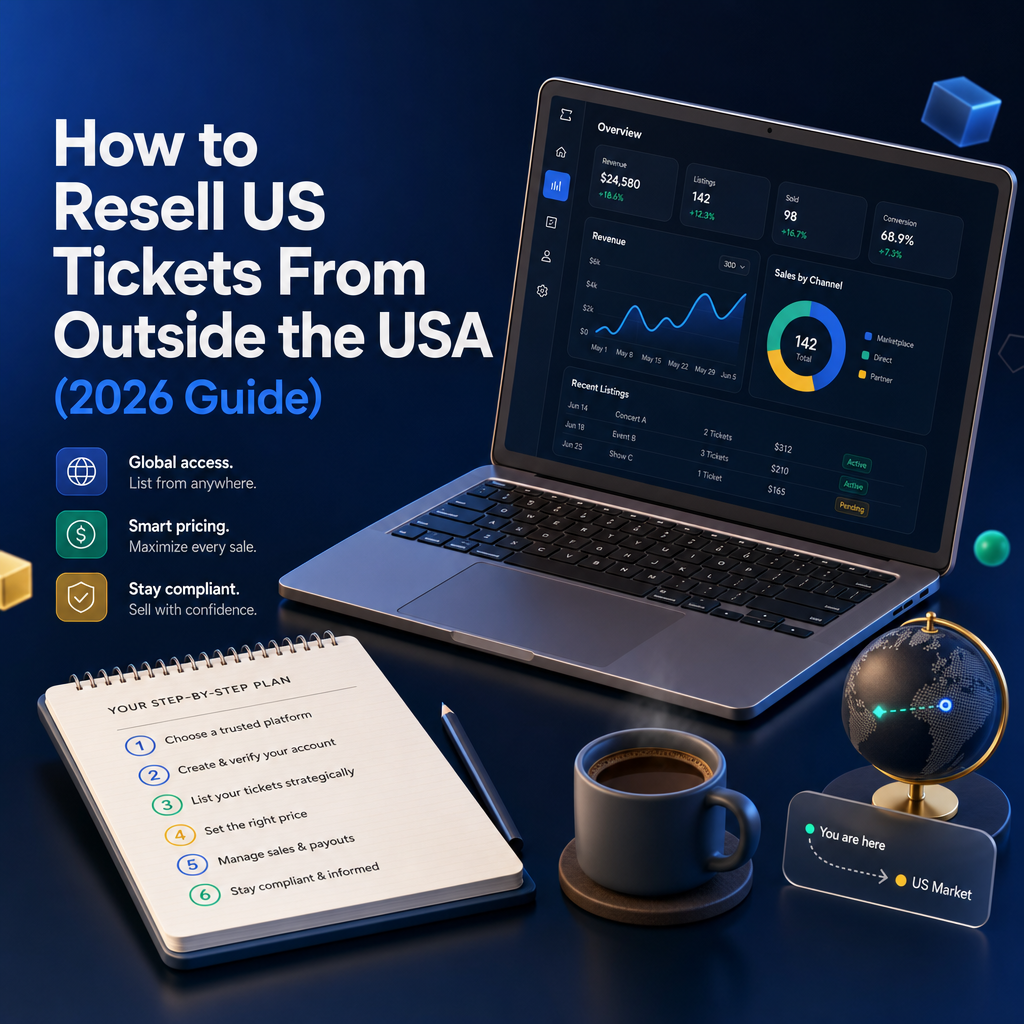
Reselling tickets to US concerts, sports, and theater while living outside the United States is absolutely doable in 2026, and thousands of people do it. The catch is that every step of the US ticket economy quietly assumes you are physically in the country: marketplaces want a US billing address, primary sites send verification codes to US phone numbers, payouts land in US bank accounts, and tax forms are written for US residents. None of these are walls. They are logistics problems, and each one has a clean, legitimate solution once you know what it is.
This guide walks through every obstacle an international reseller hits, in the order you actually hit them, and shows the practical fix for each. The goal is not to trick anyone or evade lawful identity checks. It is to operate as a real, verifiable US shopper and seller: real names, real addresses, real verification, real payment, and proper tax compliance. Follow the terms of each platform you use and the laws in both your country and the US, and treat the tax section as a prompt to talk to a professional, not as advice.
Why It Works (and Where People Get Stuck)
The economics are simple: demand for US events is global, but supply (the original face-value tickets) sells first to people who look domestic at checkout. If you can present as a US-based buyer, complete verification, and pay cleanly, you can acquire inventory that international buyers usually cannot, then resell it on the same US marketplaces. The friction is almost never the buying interest. It is the five or six identity and money plumbing steps below. Solve those once, build a repeatable system, and the rest is just inventory selection and pricing.
Step 1: US-Based Buyer Accounts and Identities
Primary sellers and marketplaces tie accounts to a name and a billing/shipping address. As an international operator you need legitimate US-format identities: a real name, a deliverable US street address, city, state, and ZIP that pass validation. A single account is rarely enough at scale, because most primary on-sales cap orders per account, so serious resellers manage a pool of accounts.
- Use real, deliverable US addresses. Addresses that fail validation get orders flagged or canceled. You want correctly formatted, real US addresses, not invented ones.
- Keep accounts organized. Track which name, address, email, and phone belong to each account so verification and payouts never get crossed.
- Do not share login fingerprints carelessly. Reusing the same email or device pattern across dozens of accounts is the fastest way to get a cluster flagged.
This is exactly the problem the ProTickets buyer account generator was built for: it creates real, verified names and addresses worldwide, including US addresses, which you can then import and manage in bulk. Instead of hand-building identities one at a time, you generate a clean pool, import it, and keep every account's details in one place.
Step 2: A US Phone Number and Receiving SMS/Email OTP Codes
Account creation, presale registration, and checkout all increasingly require a one-time passcode (OTP) sent by SMS or email, and many primaries specifically want a US number. This is where most international resellers stall: they create accounts, then never see the code because it was texted to a number they cannot read.
You will need two things. First, US phone numbers. ProTickets does not sell phone numbers, so source these from a reputable third-party US number provider (carrier eSIMs or a compliant business SMS provider are the durable options; cheap disposable VoIP numbers often get rejected by primaries). Second, and this is the part people miss, you need a reliable way to actually capture the codes as they arrive, across many accounts, without logging into dozens of mailboxes and phones by hand.
That capture step is what ProTickets Inbox handles. It pulls verification (OTP) and presale codes from your connected email accounts and SMS numbers and organizes them by account, so when a code lands during a hot on-sale you can read and use it in seconds. It is included on Pro for up to 100 accounts and on Premium for up to 1,000 accounts, which is the difference between manually juggling a handful of logins and running a real operation.
Step 3: US Payment Methods That Do Not Get Canceled
A foreign-issued card on a US billing address is one of the most common reasons orders get auto-canceled: the address-verification (AVS) check fails because the card's country and the billing address do not match. To buy cleanly you want a payment method that matches the US identity on the account.
- US-issued cards or US-funded wallets. Cards that pass AVS against the US address on the account are the safest. Some international fintech accounts can issue USD cards with US-format details; confirm they pass AVS before relying on them.
- Match name, address, and ZIP exactly. Even a small mismatch in ZIP can trigger a decline or a later cancellation.
- Avoid known prepaid BINs on big on-sales. Some primaries block certain prepaid card ranges; test with a small purchase before committing.
- Keep a payment method tied to each identity. Mixing one card across many differently named accounts looks like fraud to risk systems.
Step 4: Appearing as a US Shopper (Residential US Connection)
Buying US tickets from a foreign IP address is a red flag to risk engines, and some on-sales are geofenced to the US entirely. To present as a genuine US shopper you generally need a US residential internet connection. ProTickets does not sell proxies, so this is a third-party piece: use a reputable US residential connection or proxy service, and choose providers that source IPs ethically and let you stay on a stable region.
- Prefer residential or mobile US IPs over datacenter ranges, which are easier to detect and block.
- Keep a consistent region per account. An account whose address is in Texas but whose IP jumps between states every session looks suspicious.
- Stay within each platform's terms. The aim is to appear as the US-based shopper you are operating as, not to defeat lawful security controls.
Step 5: Where and How to List and Sell
Once you hold inventory, the US resale marketplaces are open to international sellers as long as your account and payout details are in order. The main venues:
- StubHub: the largest US resale marketplace, deepest buyer pool, accepts international sellers with valid payout setup.
- SeatGeek: strong mobile demand and clean transfer flow; good for fast-moving events.
- Vivid Seats: broad reach and frequent buyer promotions.
- TickPick: no buyer fees, which can move price-sensitive inventory faster.
- Pro multi-listing: serious resellers list the same inventory across several marketplaces at once through a listing/integration tool, with auto-delisting when a ticket sells so you never double-sell.
Pricing is where data wins. Knowing real demand, comparable listings, and how a given event is trending keeps you from underpricing scarce seats or sitting on dead inventory. ProTickets tracks market data across 250,000+ events at 50,000+ venues, plus a presale code database and price monitors, so you can decide what to buy and how to price before you commit capital.
Step 6: Getting Paid Across Borders
US marketplaces pay sellers into US bank accounts, usually by ACH, and sometimes onto PayPal. The challenge for a non-US resident is turning that USD payout into spendable money at home without losing a fortune to fees or having payouts rejected.
- Wise: provides US account and routing numbers that can receive ACH payouts, then converts to your home currency at close to the real exchange rate.
- Payoneer: widely supported by marketplaces, gives you US receiving details and global withdrawal, popular with cross-border sellers.
- A real US bank account (if you can legitimately open one) is the cleanest path for ACH and avoids third-party holds.
- Match the payout name to the account. Payouts to a name that does not match the marketplace account are a frequent cause of frozen funds.
Whatever you use, confirm the marketplace accepts it for payouts before you list, and keep a record of every payout for the tax step below.
Step 7: Delivery (Mobile Transfer vs Physical)
Most US tickets in 2026 are mobile, which is good news for an international seller because you never touch paper.
- Mobile transfer: the standard. You transfer the ticket electronically to the buyer's email or marketplace account, no shipping, no border, no customs. This is why mobile inventory is the easiest to resell from abroad.
- Marketplace-managed transfer: some platforms handle the transfer for you once a sale closes; follow their flow exactly and within their deadline to avoid penalties.
- Physical or hard-stock tickets: rare now and a headache internationally because they require shipping and arrive on a timeline. Avoid physical-only inventory unless the margin clearly justifies courier costs and the risk of delay.
- Mind transfer deadlines. Late delivery is the top cause of seller penalties, so deliver promptly when a sale notification arrives.
Step 8: Taxes and Compliance for Non-US Residents
This is the step most quick guides skip, and it is the one that gets people in real trouble. If a US marketplace pays you, it has US tax reporting obligations, and you have responsibilities both in the US and at home.
- W-8BEN: as a non-US person receiving US-source income, marketplaces will typically ask you to complete Form W-8BEN. It certifies your foreign status and can reduce or set US withholding under a tax treaty between the US and your country. Fill it out accurately; an incorrect or missing W-8BEN can mean higher withholding or held payouts.
- 1099-K reporting threshold: US payment platforms report seller payouts to the IRS on Form 1099-K. The reporting threshold has shifted in recent years and continues to change, so do not assume a number from an old article. As of the 2026 cycle the threshold has been moving toward lower totals, which means more sellers get reported, so verify the current threshold for the tax year you are selling in.
- Keep clean records. Log every purchase cost, every sale price, every fee, and every payout. Your taxable position is profit, not gross sales, and you cannot prove your costs without records. Good bookkeeping also makes the W-8BEN and any home-country filing far easier.
- Declare income at home. Your country almost certainly taxes worldwide income. Reselling profit is income, and tax treaties exist to prevent double taxation, not to let it go unreported.
This is general information, not tax advice. Cross-border tax for resellers depends on your residency, your country's treaty with the US, and the amounts involved. Consult a qualified tax professional who handles cross-border income before you scale.
Step 9: Chargebacks and Disputes Across Borders
Disputes are part of any resale business, and being abroad makes them slightly harder because you cannot always respond on US business hours and you are dealing with platforms that default to protecting the buyer.
- Deliver provably and on time. The single best defense against a dispute is a clean, timestamped transfer through the marketplace's own system.
- Keep every confirmation. Save order confirmations, transfer receipts, and message threads. If a buyer claims non-delivery, your records win the case.
- Understand each platform's seller protection. StubHub, SeatGeek, Vivid Seats, and TickPick each have their own dispute and guarantee rules; know them before you have a problem.
- Watch payment-side chargebacks. A buyer can dispute through their card issuer even after a marketplace closes a sale. Promptly supplied evidence is what reverses these.
- Respond fast. Disputes have deadlines. Set alerts so a time-zone gap never costs you a case by default.
Frequently Asked Questions
Is it legal to resell US tickets if I live abroad?
Reselling tickets is legal in most places, and US marketplaces accept international sellers. What matters is operating honestly: real identities, proper payment, following each platform's terms, and reporting your income. Some US states and venues have specific resale rules, so check the rules for the events you target.
What is the hardest part for an international reseller?
For most people it is the verification step: having US identities, US numbers, and a reliable way to actually receive the SMS and email OTP codes during a fast on-sale. Solving identity capture and OTP capture up front removes the bottleneck that stops everyone else.
Do I need a US bank account to get paid?
Not necessarily. Services like Wise and Payoneer give you US receiving details (account and routing numbers) that can accept ACH payouts and then move the money to your home currency. A real US bank account is the cleanest option if you can legitimately open one.
Will my orders get canceled for being international?
They get canceled when something does not match: a foreign IP, a foreign-issued card failing AVS, or an address that fails validation. When your identity, US connection, and US-matching payment method all line up, cancellations drop sharply.
How many accounts do I need?
It depends on volume and on per-account order limits during on-sales. Hobby sellers run a handful; serious operations run dozens to hundreds, which is why bulk account generation and per-account OTP organization matter so much at scale.
Can ProTickets provide phone numbers and proxies?
No. ProTickets generates real US-format identities and addresses and captures your OTP and presale codes from connected email and SMS accounts, plus provides market data, monitors, and a presale code database. Phone numbers and residential US connections are separate third-party services you source yourself.
Putting It Together
Reselling US tickets from outside the country is a chain of small, solvable problems: US identities and addresses, a US number and a way to receive its codes, US-matching payment, a US connection, the right marketplaces, a cross-border payout rail, clean mobile delivery, and proper tax compliance. Miss one link and orders cancel or payouts freeze. Get all of them right and you have a real, repeatable operation.
Several of those links (real US identities and addresses in bulk, OTP and presale code capture by account, and the market data to buy and price well) are exactly what ProTickets was built to handle. Plans run from Lite at $9.99 to Pro at $29.99 (Inbox up to 100 accounts) to Premium at $99.99 (Inbox up to 1,000 accounts) per month. Pair that with a reputable US number and connection provider, a cross-border payout service, and disciplined tax records, and the distance between you and US inventory stops being a barrier.
Related articles
Ready to become a ticket broker?
Join ProTickets and get access to pro-grade tools, live data, and insider strategies trusted by top resellers.
Get started for free